Skip to Main Content

Skip to Main Navigation


70 Vane

Click the image above to zoom in.

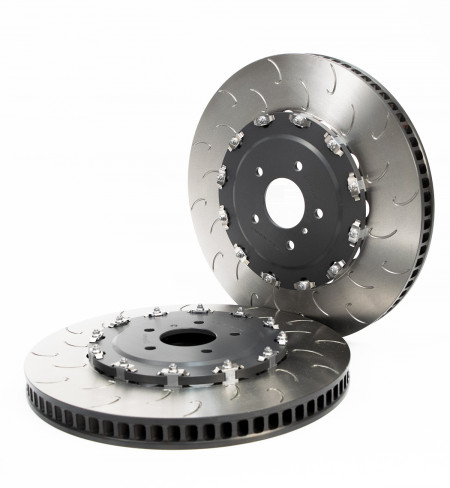
AP Racing 12.81" x1.25" (325mm x 32mm) Heavy Duty, 70 Vane, J Hook Racing Brake Disc

Retail Price: $249.00
Part #: 19 01 912

12.81" x1.25" (325mm x 32mm) Heavy Duty, 70 Vane, J Hook Right Hand Iron Racing Brake Disc

PDF Installation Drawing (68 KB)

Buy Now

Add Items to Cart

Product Review Form
Close


AP Racing's Heavy Duty J Hook Racing Discs were specifically designed to handle racetrack abuse.  These are the same discs used on the fastest cars at the elite level of motorsports, including ALMS, NASCAR Sprint Cup, etc.  They provide increased cooling, less judder, fewer cracks, and an increased service life vs. competing discs.  When you run an AP disc, you can be confident that you're using the best parts available at any price point.

Feature: 70 directional vanes, 16.5mm air gap

ap_racing_heavy_duty_j_hook_325x32mm_012_400

Most aftermarket discs have 30 to 48 vanes.  Many times those vanes are straight, or non-directional, with a sub-optimal amount of space between disc faces.  After extensive CFD and thermal stress analysis, AP designed the Heavy Duty J Hook with 70 vanes and a wide 16.5mm air gap to increase airspeed and heat transfer, while reducing deflection and remaining reasonably lightweight.

Benefits

The increased directional vane count on the J Hook Heavy Duty Disc amplifies air speed through the disc, reduces air recirculation between vents, and also increases convective heat transfer and heat distribution.  In other words, both air and heat move more quickly and evenly through the disc, creating increased stability under the extreme loads of racetrack use.  The disc is less prone to coning, distortion, and cracking, while providing cooler running temperatures, less brake fade, reduced judder, and a longer service life.

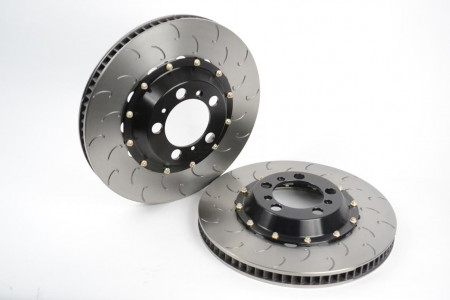
Feature: Exclusive AP Racing J Hook slot pattern

ap_racing_heavy_duty_j_hook_325x32mm_007_400

When you cut a slot or drill a hole in a disc you impact heat transfer. The area around the slot or hole acts as a cool spot when the disc heats up, which is not ideal. Ideally, heat is distributed uniformly around the disc so it can be hit with the cooling air that is pumping through the disc, radiate outwards away from the disc, etc.  Cool spots create stress risers and increase the likelihood of the disc cracking. They also cause the face of the disc to distort unevenly, leading to uneven pad deposits, vibration, and judder.

Benefits
During exhaustive R&D testing, AP's J Hook design was found to create a constant pathway of evenly distorted material on the face of the disc.  The hooks are spaced out as evenly as possible both around the circumference of the disc, as well as from the inside edge (where the hat attaches) to outer edge, with a slight overlap to promote even heat distribution/distortion. In addition to reducing cracking, the even heating of the disc also helps provide an even transfer layer of pad material on the disc when you bed them in.

Additionally, the J Hook slot pattern produces a greater number of leading edges for the pads to bite into vs. a traditional curved slot pattern.  While this may lead to slightly more whirring or scraping noises from the discs when applying the brakes, the benefits of more even heat distribution, less propensity to crack, cleaner pad material transfer during bed-in, and more bite far outweigh the slight increase in NVH for the serious enthusiast.

Feature: Complex metallurgy developed through 50+ years of experience

ap_racing_heavy_duty_j_hook_325x32mm_008_400

AP Racing has been designing brake components for more than 50 years.  They've had their components on cars that have won more than 600 grand prix's (Formula 1).  On any given race weekend, AP J Hook discs can be found on 75% or more of the NASCAR Sprint Cup grid.  AP has learned from these experiences, and have developed a proprietary iron alloy with extreme durability, designed specifically for what you intend to do with it (flog the hell out of it). 


dyno_test_ap_disc_700


Benefits

Elite level teams choose AP Racing because they know the work has been done to provide the best available product at any price level.  The AP Heavy Duty J Hook is a direct derivative of AP's vast racing experience.  You can buy with confidence knowing that you're getting the best product available at any price point.  A note of caution however: the J Hook design is often imitated, and there are a number of lesser quality imitations on market.  Before purchasing, make sure you are getting an authentic AP Racing J Hook!


Feature: Reasonable replacement cost

pile-of-cash_400

Let's face it, no matter how good a brake disc is, it's still a consumable item.  They're no different than brake pads or gasoline.  You beat them up until they crack to pieces, then you throw them away.  If replacement iron is too expensive, you're always driving in fear, waiting to shell out big bucks for a new set.  Despite having the most expansive set of features on the market, the 325x32mm Heavy Duty J Hook's retail for a budget-friendly $249 each.

Benefits

Going to the track is expensive!   Event entrance fees, hotels, fuel, and tires all add up.  While you obviously want the best product available, you can't afford to pay a small fortune for something you're just going to destroy.  You can buy a cheap set of $150 discs for every event, have relentless heat issues, and find yourself constantly swapping them out.  Or, you can buy a high quality set that could potentially last you an entire season.  When you do the math, the long-term value of the AP J Hook's is tough to beat.  You'll enjoy all the benefits without breaking the bank, and you'll spend more time driving and less time wrenching.

ap_rotor_with_pads_on_fire_400


Endurance testing at Essex- We know what you'll be doing to these discs, so we make sure they're up to the task.


Disc Bedding and Preparation

For an in-depth look at disc bedding, please visit the Essex Learning Center and watch our video entitled: How to Bed-in Brake Pads and Rotors.


Disc Mounting

Most racing and many high performance road brake discs are designed to be mounted on to the hub or stub axle by means of a Mounting Bell.

Mounting Bells are usually made from high grade aluminium alloy although other materials can be used. This arrangement is much lighter than a one piece disc and bell, but more importantly allows some compliance to reduce the risk of distortion due to heat expansion of the disc. This becomes more important the larger the disc and is considered essential above 330mm diameter.

There are essentially two methods of attaching the disc to the bell, "bolted," and "floating." The method to be used will depend on the particular application being considered.

For lower duty applications and on smaller discs a bolted mounting is sometimes preferred for strength and simplicity, especially for off-road applications (e.g. Rallies) where debris may clog a floating mechanism leading to run-out and disc vibration. Stiff flat bells should be avoided with a bolted mounting.

Discs for heavy duty applications, especially larger discs, should be mounted to allow axial float and radial heat expansion of the disc.  Radial float allows differential expansion of disc and bell thus reducing stresses in the disc and minimising disc cracking and distortion. The idea of axial float is to compensate for a certain amount of stub axle / upright flex by allowing the disc to take up its ideal position within the range of float thus avoiding "knockback" of the caliper pistons. However the float should not be excessive as disc gyroscopic loads can cause the same effect that the float is trying to alleviate. The amount of axial float will depend somewhat on the application.

Disc Temperatures

In order to achieve optimum racing brake performance and prolong disc life it is essential that the brakes operate at the correct temperature. In general discs should run at similar temperatures front and rear and from side to side, dissimilar temperatures will lead to varying brake balance.

Temperature balance can be checked as soon as the car stops in the pit lane using a Pyrometer such as AP Racing Pyrometer kit CP2640-24. However a pyrometer reading is not a good indicator of disc operating temperature which decays rapidly with time when the brakes are not being applied.

Under racing conditions disc bulk temperatures should normally be maintained in the range 400°C to 600°C (752°F to 1112°F) for best performance. Disc face peak temperatures may be higher but should not exceed the maximum recommended for the pad material being used.

Temperature Paint Kit

An effective method of checking maximum disc operating temperature is by using temperature paints applied to the disc. A suitable AP Racing paint kit can be purchased here.  This kit contains three paints, Green (turns white at 430°C), Orange (turns yellow at 560°C) and Red (turns white at 610°C) plus thinners and brushes.

Material Safety Data Sheet (MSDS) MSDS for Thermal Paint Kit (English, French, German, Italian and Spanish) can be downloaded Here

When assessing brake temperatures it is important to complete several successive laps (5 or preferably 10) at race speeds and vehicle weight to allow temperatures to stabilise at a representative level.

Typically when running within the correct temperature range the Green paint (430°C / 806°F) will turn throughout, the Orange paint (560°C / 1040°F) 50% to 100% throughout and the Red paint (610°C / 1130°F) turned up to 5mm from each brake face. If the Red paint (610°C / 1130°F) turns throughout, the discs are running too hot.

Circuits and drivers vary enormously in the amount of work they demand from the brakes and therefore the brake system has to be tuned for each circuit by adjustment of the cooling airflow. The temptation to over cool the disc should be resisted. The aim is to keep the temperature as stable as possible within the working temperature range. High maximum to low minimum temperature cycles are the enemy of disc life.

Disc Cooling

A good source of cooling air should be supplied preferably through the upright to the disc throat. A typical venting cross section of 100cm² (16in²) is usually sufficient. The pick up should preferably be in an area of clean high pressure air flow and the ducting should be arranged to avoid sharp bends or changes in section which may choke the air flow.

Safety & Care of Discs

Cast iron brake discs should not normally be operated at bulk temperatures in excess of 6l0°C (1130°F) and above rotational speeds of 3000 revolutions per minute.

Discs must be regularly and frequently inspected for excessive heat checking and cracking.

Discs with cracks emanating from mounting holes / slots, inside diameter, scallops, or outside diameter should be changed immediately.

After heavy and prolonged use some surface checking will often be evident. If this turns into distinct surface cracks which are radiating towards the inside or outside diameter the disc should be changed.

IF IN DOUBT REPLACE

Disc Handing & Identification

Most AP Racing Brake Discs feature Curved Vanes. The brake discs are handed and should be installed with the cooling vanes running back from the inside to outside diameters in the direction of rotation as indicated in the sketch.

discdir_250


Essex Part #19 01 912
Manufacturer Part #CP3908-102GA

Unable to retrieve comparison products. Sorry for the inconvience.
To find other products that match your vehicle try using our vehicle filter at the top of the page.

There are currently no reviews for this product.